Interview: business meals & handshakes

How to: Handshakes in the business world
Etiquette Skills Essential in Business
Interview of an Etiquette Instructor

Q) What is the biggest NO-NO during a business lunch: Spaghetti? Burping? Slurping? Elbows on the table?

A) That is a tough one since there are many pitfalls for business meal manners.  However, I believe the biggest no-no is ignoring everyone at the table or interrupting fellow diners.  The table is a place to share and during the business meal that means polished communication skills are necessary. 

Additionally, shoving food into your mouth, holding a fork as a shovel, and hovering over a meal conveys more interest in eating rather than those at the table.  It also displays a lack of table manners.

Table manners speak volumes about a person.  If a diner pushes food onto a fork with a finger, burp, slurp, or plants their elbows on the table, it conveys indifference of dining partners—as if they are unimportant. 

The most important dining rule is that we all feel comfortable at the table, and we are not comfortable with sloppy or disinterested diners.

Q)  Please describe the perfect handshake.

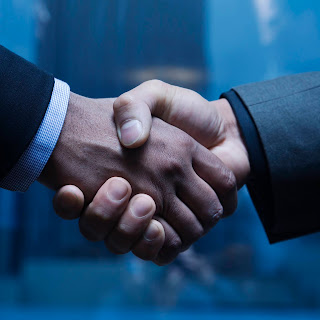
A) Due to the pandemic and future outbreaks, handshakes are imprudent.  In fact, elbow bumps, a nod, or fist bumps are now acceptable. However, if the importance of handshakes return...here we go.  

The perfect handshake begins with an extended dry right hand.  Grasp another’s hand as tightly as your he/she does, not too tightly, never wimpy, and shake gently, yet assertively.   All the while, each keeps eye contact while smiling.  That said, cultural differences need to be considered like eye contact and smiling.  However, in this culture, eye contact, smiling and a good handshake is a trust issue.

Q)  Please list some rules, like making eye contact, sitting up straight, elbows on the table, etc.

For table manners:

  • Always remember, that you want everyone to feel comfortable.
  • Do not hover over your food; sit up straight.
  • Do not hold your utensils like shovels.
  • Elbows should be close to your sides, not flapping about or placed on the table.
  • Cut and eat one bite at a time.
  • Chew with your mouth closed and do not stuff your mouth.
  • Do not reach.
  • Never place a utensil on the table after it has been used.
  • Do not blow on hot food.
  • Gristle is removed from the mouth with utensil and placed on the plate.  
  • No hats at the table.  That includes baseball caps.
  • Do not apply lipstick, clean fingernails, or comb hair at the table.
  • If unsure of what to do, watch the host.
  • Always use the utensil that makes the most sense.
  • We all share and learn about each other at meals.
  • No cellphone use.
  • The essence of good manners is caring for those around you.
For conversation:
  • Keep good eye contact.
  • Allow everyone to have a turn to speak.
  • No interrupting.
  • Stay current, keep up with current events.
  • No ethnic slurs or degrading language.
  • Listen.

For all of us:

Treat others as you wish to be treated, with respect, kindness, and courtesy. 

More by Rebecca

The Importance of an Elevator Speech

Time to Polish Our Professional Presence

Job Seeking Using the Internet & Good Social Skills 

Comments

Popular posts from this blog

When is it Appropriate to Give Gifts to Supervisors

  Dear Rebecca, I've read your comments regarding office gift -giving online.    What guidelines apply when gifts are to a departing supervisor?    When the departure also causes the termination of others on the supervisor's team, should they also receive gifts? Thanks, Michael Dear Michael , Good question.   It is always optional to give gifts , especially in the workplace.   So, there is no firm 'guidelines' about giving to departing supervisors.   However, if it’s customary to give gifts to those who depart in your workplace, then everyone who is leaving should receive one.   It would be expected.   The gifts shouldn't be expensive and could be a farewell lunch or office party with a cake and beverages. Sincerely, Rebecca More by Rebecca How Our Actions Can Affect Our Professional Image       How to Eat Difficult Foods at a Business or Social Function Interview: business meals & ...

Good Manners are Important for Job Seekers & University Students

Interview with an Etiquette Consultant As an etiquette consultant, I'm often interviewed. Many of these interviews concern the importance of using good manners in the workplace. What follows are the most often asked questions and my replies.  Question Are manners important in the workplace and does it give someone an edge? My Reply One of my favorite quotes is “Our good manners are the key to open doors of opportunity.” Good manners are perceived by others as excellent "people skills", which are so highly prized by employers. Those with excellent people skills are those who succeed. Question  It appears that college students are primarily focused on how much they will earn when graduating, but sincerely lack finer personal skills. Will this hurt them in the workplace?  My Reply Unfortunately, yes. Too often university students think that if they narrowly focus on their studies, a huge paycheck is guaranteed. While it is true that employers are looking fo...

Office Etiquette 101: How to Deal with Frustrating Breakroom Behavior

  Stealing Lunches, Burning Microwave Popcorn, Hogging the Fridge...Oh My! At work, the lunch or breakroom is often a place to mingle or hide out during breaks.   Sometimes, though, it can be a place of crime.   Crime in the workplace?   Oh yes.   As an etiquette consultant, one of the most common workplace complaints I hear concerns the lunch thief.   Thievery isn't the only breakroom complaint, however.   Therefore, I've developed a few tools to deal with this diverse group of breakroom irritants and offenders.   What causes some employees to exhibit such poor behavior? When frustrated with coworkers, many will come to me with their workplace stories and questions.   The first question is usually about why their coworkers would steal their lunch or warm smelly fish in the microwave.   The answer is simple: Most forget that the workplace is a shared space, so they become too comfortable and forget to use their best manners. ...